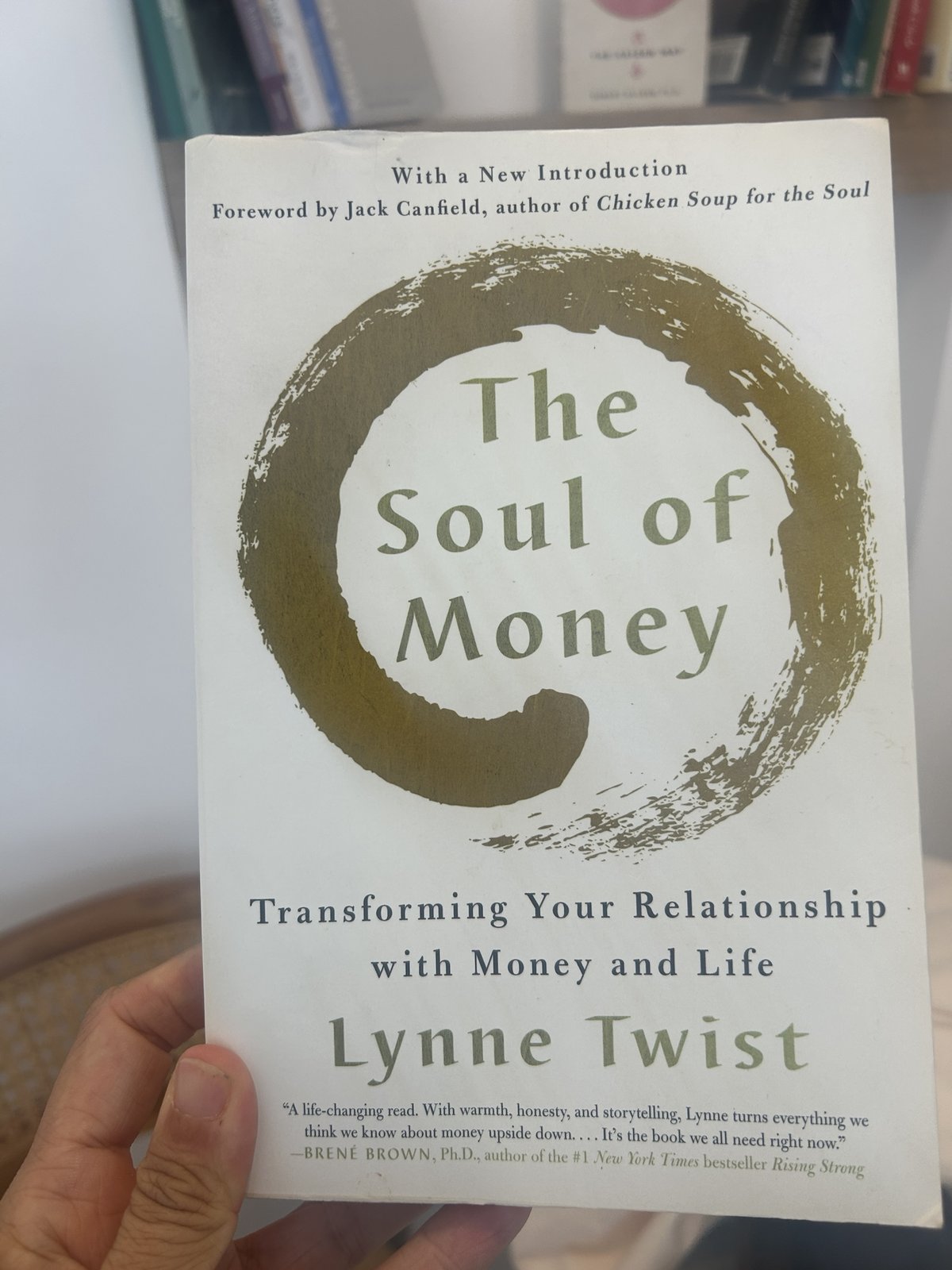
I just finished reading The Soul of Money by Lynne Twist and it was really good. This book was extra special because I read it cover to cover out loud with my partner and I taking turns. We started reading it over a year ago before we moved to Bali.
Lynne spent decades as a fundraiser working to end world hunger. That work put her in rooms with some of the wealthiest people on the planet and in villages with some of the poorest, sometimes in the same week. What she noticed is that both groups were often living inside the same story about money, and it is a story most of us never chose. We just inherited it.
My partner Jarin and I are both entrepreneurs but also yogis and people who want to live a conscious life that is aligned to our spiritual principles. I hadn't found many good books that covered the spiritual side without going overboard in one direction, so I was skeptical at first, but after finishing it I can say that this is a really great book and courageously defines where we could align our efforts towards. I like her vision.
She calls the story, the story of scarcity, and she breaks it down into three toxic myths.
Here are the three and what each one brought up for me.
Toxic Myth #1: There's Not Enough
This is the one that runs underneath everything. Not enough money, not enough time, not enough sleep, not enough clients. It seems like nations feel this and go to war over it. Companies feel this and don't take care of clients or citizens because of it.
The myth is not about how much there actually is. It is a starting assumption, and when I start from "not enough", everything I do becomes about making sure I am not the one left out. That is a tiring way to live and it does not make for generous decisions.
Growing up with immigrant parents I definitely have felt the scarcity mindset and unfortunately it has taken me a long time to unlearn much of it. Still a work in progress today.
Toxic Myth #2: More is Better
If there is not enough, then the logical next move is to get more. More income, more followers, more projects, more languages, more everything.
The problem is that chasing more keeps my attention on what I do not have yet, and away from what is already in my hands. More has no finish line. You can win at it for years and never once arrive.
This one landed for me because my own motto is "anything worth doing is worth doing slowly", and more is better is pretty much the opposite of that.
I remember fondly how much my father loves Costco. Don't get me wrong it is a great company which provides great services and products, but because I shopped there I had multi year supplies of things I couldn't use, like toilet paper and paper towels, that I needed to give away before I moved.
Another small example for me is that I don't like having a fully filled fridge as it makes me feel like I must finish everything before it goes bad, consuming out of force rather than what I actually need or want. Buying just to get a bargain or just to get extra is one of the consumerist habits I've been unlearning since leaving America.
Toxic Myth #3: That's Just the Way It Is
This is the one that keeps the first two in place. It is the shrug. The world is unfair, money makes people act this way, that is how business works, nothing I do will change it.
Lynne's point is that this myth is the most dangerous of the three because it sounds like being realistic. Resignation feels like wisdom, but it is really just giving up with good posture.
I firmly believe this is the dogmatic thinking that doesn't serve anyone. Doing things just because that is the way we have always done things is ridiculous and crazy. We are all evolving and growing and we should be willing to change our minds, attitudes, behaviours, etc...
What She Offers Instead: Sufficiency
The alternative she offers is not abundance, which surprised me. It is sufficiency. Not a quantity, but a way of seeing: there is enough, and I am enough.
The idea from the book that has stayed with me most is that when you stop trying to get more of what you do not really need, it frees up a huge amount of energy to make a difference with what you already have. And what you pay attention to and appreciate tends to grow.
I started keeping track of all my expenses through a manual process that started with a spreadsheet in college and since then have continued the evolving practice. What I took away from this book is how we think about money makes a really big difference. If I find myself living in the previously mentioned myths of scarcity I can always journal or talk about it and get realigned to myself. This is what is possible with Soul.
If money is something that brings up stress for you, or if you just never think about your relationship with it at all, I really recommend this book. It is less about money than it is about how we want to live.
Comments